Connect My School Initiative: Advancing Inclusive Digital Education in Cameroon
- 12 mars 2026
- 0
In the Northwest and Southwest regions of Cameroon, where protracted crises and infrastructural constraints severely impede equitable access to quality education, the Connect My School initiative, spearheaded by UNICEF Cameroon in strategic partnership with IHS Cameroon (a subsidiary of IHS Towers, NYSE: IHS), represents a significant stride towards sustainable and inclusive digital learning.
Formally launched on 15 May 2025 in Yaoundé, this collaborative endeavour seeks to bridge the digital divide by providing children and adolescents in vulnerable and crisis-affected areas with meaningful opportunities for technology-enhanced education.
Central to the initiative is the e-container: a purpose-built, eco-conscious learning hub constructed from recycled materials, powered entirely by solar energy, and equipped with state-of-the-art computers, tablets, reliable internet connectivity, and curriculum-aligned digital pedagogical resources. These secure, dedicated spaces facilitate the development of foundational skills in literacy, numeracy, and languages, while cultivating essential 21st-century competencies such as critical thinking, problem-solving, and innovation.
Landmark Inauguration in Limbe
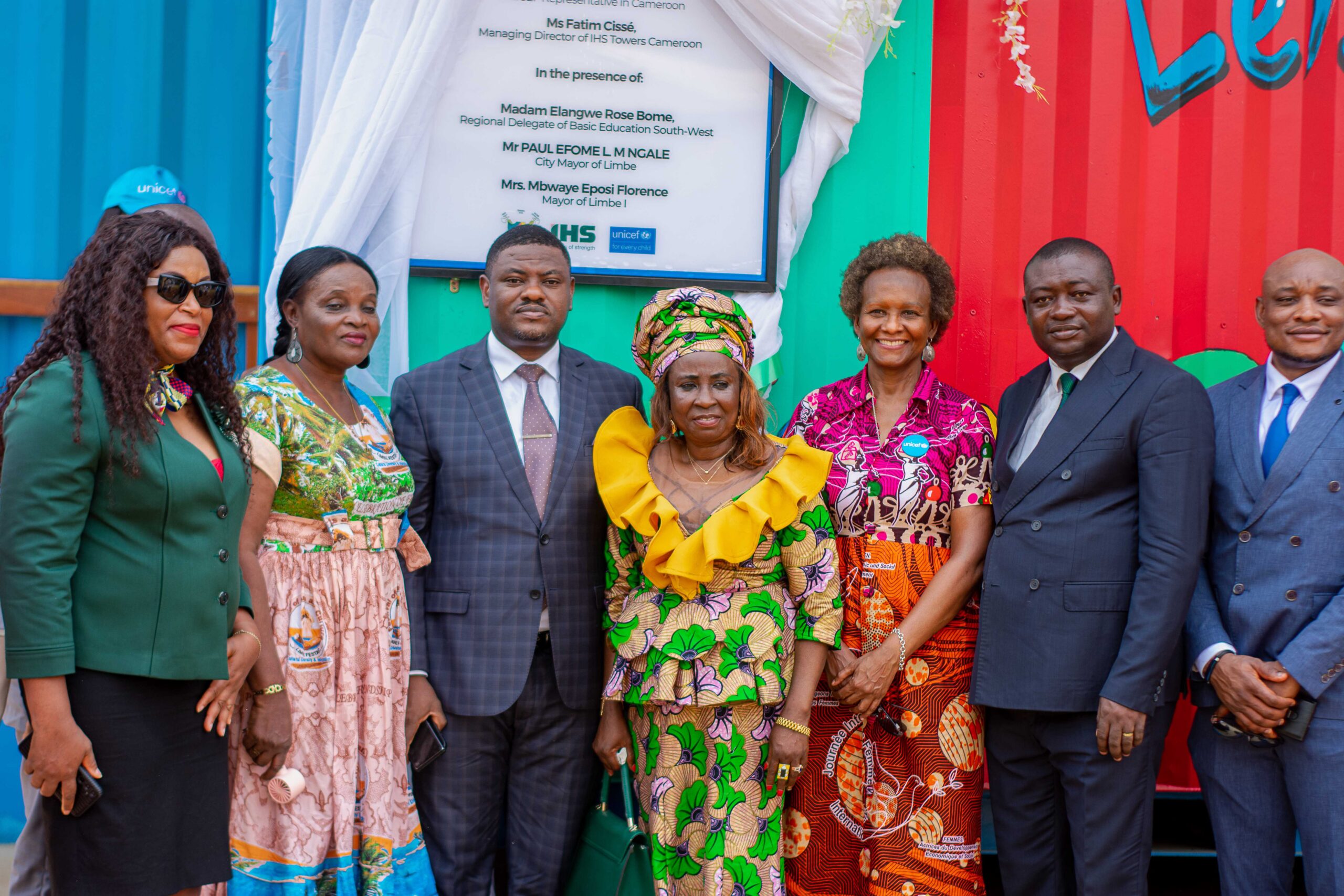
On 5 March 2026, the inaugural e-container under this specific partnership was solemnly inaugurated in Limbe, Southwest Region. The facility directly serves over 600 children from four partner institutions: Government Practising School Mile 1 (Groups 1 and 2), Government Practising School Towe, Francophone Public Practising School Mile 1 (EPPFD)
Marking the third such installation supported by IHS in Cameroon, this solar-powered hub ensures uninterrupted access to digital learning in environments frequently disrupted by insecurity or logistical challenges.
Capacity Building for Educators and Community Engagement
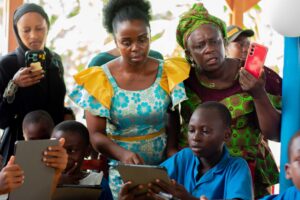
In the lead-up to the inauguration, educators from the beneficiary schools underwent rigorous professional development in digital pedagogy, delivered by technical partner Nervtek. Participants acquired proficiency in practical tools including Scratch, Medibang, Paint, and PowerPoint enabling them to integrate interactive methodologies into the teaching of mathematics, sciences, history-geography, and languages. These transformative sessions not only enhance student engagement but also empower teachers to disseminate best practices within their professional networks.
Complementing these efforts are targeted bootcamps for learners to foster digital fluency, alongside orientation sessions for school management committees and parents, ensuring broad community ownership and long-term sustainability.
Alignment with Global Priorities and Enduring Partnership
The initiative aligns seamlessly with UNICEF’s Digital Education Strategy 2025–2030 and advances the Sustainable Development Goals, particularly those pertaining to quality, inclusive education and environmental stewardship through renewable energy and recycled infrastructure.
Building on a longstanding collaboration between UNICEF and IHS Cameroon in the domains of education, health, and digital inclusion within crisis contexts, the project exemplifies effective public-private synergy.
The success of the e-container initiative stands as a benchmark for impactful digital intervention, largely driven by the strategic leadership and vision of Barbara Melem, Senior Manager Communications and Sustainability at IHS. Her personal contribution has been pivotal in bridging the gap between high-level conceptualization and the technical deployment of these units. Central to this achievement was her exceptional management of the long-standing, four-year partnership with IHS. By expertly aligning the initiative’s goals with the rigorous requirements of global stakeholders, she ensured the project was not only technically sound but also socially transformative. This collaborative synergy, spearheaded by Barbara Melem, has turned the e-container into a scalable model for sustainable development in underserved regions.
Olufemi Arosanyin, Chief Executive Officer of IHS Cameroon, declared at the partnership’s announcement:
“This partnership embodies our resolute commitment to advancing education and digital inclusion for children and youth across Cameroon. By harnessing technology, we aspire to establish a replicable model of sustainable development capable of reshaping the educational landscape.”
Nadine Perrault, UNICEF Representative in Cameroon, affirmed:
“We warmly acknowledge and commend IHS Cameroon’s steadfast support in enabling UNICEF to realise the Sustainable Development Goals for the benefit of every child.”
Prospects for National Expansion
The Limbe e-container constitutes merely the initial phase of a broader ambition. Preparations are underway to identify additional deployment sites across the Southwest, Northwest, and other regions, with the overarching objective of connecting thousands more learners, further capacitating educators, and establishing a scalable framework adaptable beyond Cameroon’s borders.
In urban centers such as Douala and the Littoral Region where analogous initiatives have already demonstrated efficacy this momentum reinforces the conviction that innovative partnerships can decisively advance equitable, technology-enabled education for Cameroon’s future generations.
Francine Ntamack